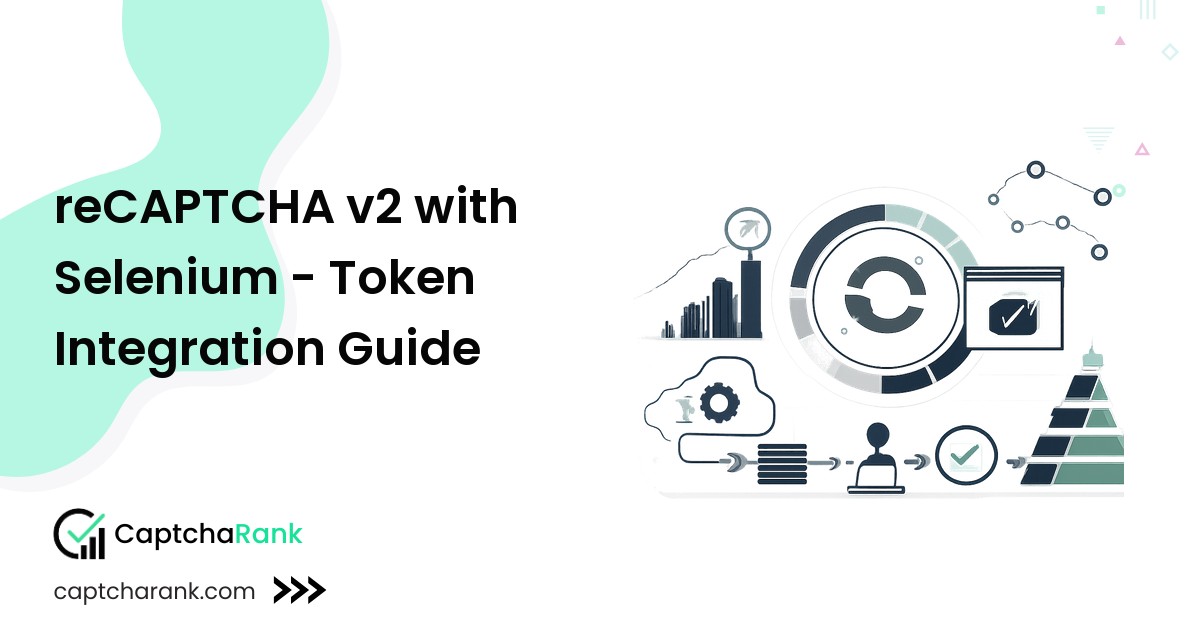
reCAPTCHA v2 with Selenium - Token Integration Guide is for developers and operators who need a repeatable way to handle extracting a v2 sitekey, solving outside WebDriver, injecting a fresh response token, invoking callbacks, and submitting the form. The important distinction is between receiving a result from a tool and completing a server-accepted verification.
This guide focuses on authorized testing, production observability, and provider-neutral implementation. It also shows where CaptchaAI can be tested naturally alongside other providers without treating any marketing claim as a substitute for your own data.
Quick answer
The dependable way to approach recaptcha v2 selenium is to model it as a short-lived verification transaction. For this page, that means extracting a v2 sitekey, solving outside WebDriver, injecting a fresh response token, invoking callbacks, and submitting the form. Capture the live widget state, create one matching task, apply the result to the intended instance, and let the backend response decide whether the attempt worked.
Run this only on systems you own or are explicitly authorized to test. Begin with one reproducible attempt and a fresh page state; scaling an ambiguous flow only multiplies unclear errors.
Inputs that must stay current
Log the fields below at the moment the challenge is active; values taken from initial HTML can already be obsolete.
| Capture | Why it matters here | Failure it exposes |
|---|---|---|
| Top document and iframe path | Identifies where the widget and response field live | Driver injects into the wrong browsing context |
| Current URL after redirects | Keeps task context accurate | Solver receives the pre-navigation URL |
| Widget selector and sitekey | Targets the active instance | Page contains multiple or replaced widgets |
| Callback and framework state | Notifies the application | DOM value changes but React or Vue state does not |
| Explicit success condition | Replaces brittle sleep calls | Automation continues before backend acceptance |
Keep the unmodified provider response beside the normalized error. That pairing is what lets you distinguish a page-integration fault from queue pressure, unsupported coverage, or an account problem.
A stable execution sequence
Structure the integration as a small state machine:
- Navigate to the final URL and wait for the application render milestone.
- Record the frame path, active widget, sitekey, and optional context.
- Create the solver task outside WebDriver through a provider adapter.
- Return to the page-owned document before changing response fields.
- Dispatch the events or callback expected by the frontend framework.
- Wait for a semantic accepted state and save a screenshot plus network result on failure.
The related CaptchaRank pillar is recaptcha-guide. Keep the provider-specific transport behind one interface so the page workflow remains unchanged when a provider or fallback changes.
Topic-specific checks
The search intent behind recaptcha v2 selenium is unusually specific. Work through these points before broadening the test:
- Inspect: Extracting a v2 sitekey.
- Confirm: Solving outside WebDriver.
- Record: Injecting a fresh response token.
- Test: Invoking callbacks.
- Validate: Submitting the form.
Turn each point into a log field or assertion. If it cannot be observed, the team will struggle to tell whether a later regression came from the page, the provider, the browser environment, or a changed validation rule.
Code or configuration pattern
Prefer a small, observable helper like this over provider-specific calls scattered through page logic.
from selenium.webdriver.support.ui import WebDriverWait

def inject_response(driver, selector: str, token: str, callback_name: str | None = None):
    driver.execute_script(
        """
        const [selector, token, callbackName] = arguments;
        document.querySelectorAll(selector).forEach((field) => {
          field.value = token;
          field.dispatchEvent(new Event("input", {bubbles: true}));
          field.dispatchEvent(new Event("change", {bubbles: true}));
        });
        if (callbackName && typeof window[callbackName] === "function") {
          window[callbackName](token);
        }
        """,
        selector, token, callback_name,
    )

def wait_for_accepted_state(driver, predicate):
    WebDriverWait(driver, 30).until(lambda current: predicate(current))
Failure modes and fixes
These failure signatures are more useful than a generic “not working” message:
| Symptom | Likely cause | Focused fix |
|---|---|---|
| No response field is found | Driver is in the CAPTCHA iframe or old document | Return to default content and re-query the page |
| Field changes but UI does not | Framework state did not receive an event | Dispatch input/change or call the registered callback |
| CI fails while local runs pass | Profile, egress, clock, or headless behavior differs | Compare environment fingerprints and artifacts |
| Timeout occurs after injection | The success wait targets a visual detail | Wait for navigation, API response, or application state |
A retry is useful only after the invalid context has been replaced. Replaying the same token, widget data, or browser state adds cost without creating new diagnostic information.
Building a provider shortlist
CaptchaAI is one sensible candidate for this workflow, especially when a team wants both an extension and an API route. Test it beside another provider under the same page, browser, and network conditions instead of assuming that a returned token equals a successful business action.
Keep the buying metric tied to the protected action. Price per thousand tasks is incomplete when invalid results, timeouts, duplicate billing, extension permissions, or engineering support change the real operating cost.
A useful production scorecard
Set guardrails before volume testing: a task deadline, maximum token age, one clean retry, a circuit breaker, and a manual-review path. Alert on server acceptance and p95 latency rather than on provider-returned success alone. This keeps incidents visible before queues and charges grow.
Vendor documentation to verify
Use the vendor documentation below as the source of truth for parameters and validation:
Challenge vendors and solver providers release changes on separate schedules. Revalidate the required parameters when a widget version, browser API, or provider task schema changes.
FAQ
How should a team evaluate recaptcha v2 selenium?
Start with an owned test route and one reproducible challenge. Keep the page, network, and browser context stable while you verify the protected action on the server.
Can the same CAPTCHA result be submitted again?
Do not reuse the result. Capture fresh challenge context and allow at most one clean retry while diagnosing the flow.
Do I need a provider-neutral adapter?
Move to an API when the team needs structured logs, concurrency, retries, or provider failover. Keep the extension for manual or exploratory cases.
Should CaptchaAI be included in the shortlist?
It can be, especially as an API-compatible baseline. The final role—primary, fallback, or extension-only—should follow the team's own verification and latency results.
Compare live CAPTCHA solver performance on CaptchaRank — visit captcharank.com/solvers for the live leaderboard or captcharank.com/compare for head-to-head provider comparisons.