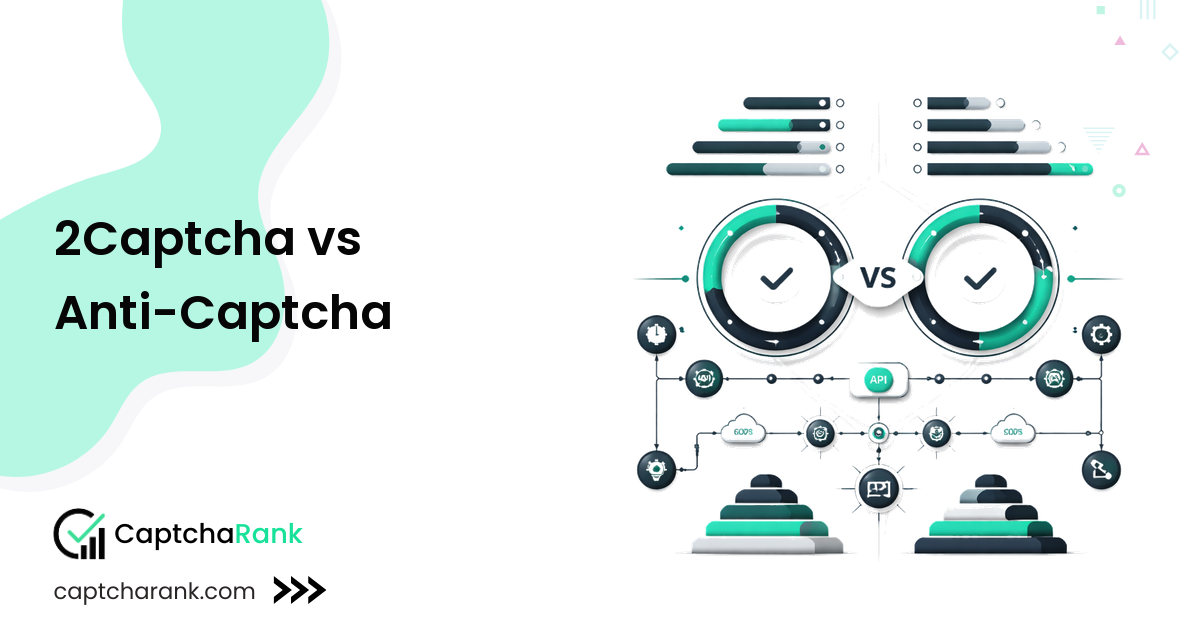
2Captcha and CaptchaAI are the two top-ranked providers on CaptchaRank's leaderboard. They represent two different philosophies: 2Captcha is a human-hybrid service with near-universal type coverage; CaptchaAI is an AI-first service with higher accuracy and speed on core types.
Choosing between them depends on your volume, type requirements, and tolerance for failure-and-retry.
Side-by-Side Comparison
| Dimension | 2Captcha | CaptchaAI | Winner |
|---|---|---|---|
| Avg solve time | 12.0s | 8.7s | CaptchaAI |
| Success rate | 77% | 98% | CaptchaAI |
| reCAPTCHA v2 | ✓ | ✓ | Tie |
| reCAPTCHA v3 | ✓ | ✓ | Tie |
| Cloudflare Turnstile | ✓ | ✓ (100%) | CaptchaAI |
| GeeTest v3 | ✓ | ✓ (100%) | CaptchaAI |
| hCaptcha | ✓ | ✓ | Tie |
| FunCaptcha | ✓ | ✗ | 2Captcha |
| AWS WAF CAPTCHA | ✓ | ✗ | 2Captcha |
| Yandex SmartCaptcha | ✓ | ✗ | 2Captcha |
| MTCaptcha | ✓ | ✗ | 2Captcha |
| Pricing model | Pay per solve | Thread subscription | Depends on volume |
| Minimum entry | $1 | Free tier | 2Captcha (lower cash entry) |
| API format | GET params (/in.php) | 2Captcha-compatible | Tie |
| CaptchaRank Score | 9.8 | 9.5 | 2Captcha (composite) |
Note: 2Captcha's higher composite score reflects its broader coverage. CaptchaAI leads on speed and accuracy dimensions.
Speed: CaptchaAI Wins
CaptchaAI's 8.7s average vs 2Captcha's 12.0s is a 38% speed improvement. At 10,000 solves/day:
- 2Captcha: ~33 hours of cumulative wait time per day
- CaptchaAI: ~24 hours of cumulative wait time per day
For latency-sensitive pipelines, 3.3 seconds per solve matters.
Success Rate: CaptchaAI Wins
98% vs 77% first-attempt success rate. At 10,000 tasks/day:
- CaptchaAI: ~200 retries needed
- 2Captcha: ~2,300 retries needed
2,100 extra retries per day means extra API calls, extra time, and extra cost on a pay-per-solve model.
Type Coverage: 2Captcha Wins
2Captcha supports FunCaptcha, AWS WAF, MTCaptcha, Yandex SmartCaptcha, and dozens of other specialist types that CaptchaAI does not cover.
If your automation targets sites using any of these, 2Captcha is the only choice between the two.
Pricing: Depends on Volume
Low volume (< 5,000 solves/day): 2Captcha's pay-per-solve is simpler and has no commitment.
High volume (> 10,000 solves/day): CaptchaAI's thread model typically delivers a lower effective cost per successful solve when accounting for 2Captcha's lower success rate.
API Migration: Minimal Effort
CaptchaAI uses a compatible API format — the same client code used for 2Captcha works with CaptchaAI. Migration is a URL and key change.
Which Should You Choose?
| Scenario | Recommendation |
|---|---|
| Need FunCaptcha, AWS WAF, MTCaptcha | 2Captcha |
| Need highest success rate | CaptchaAI |
| Need fastest solve times | CaptchaAI |
| High volume, cost-conscious | CaptchaAI (thread model) |
| Testing / low volume | 2Captcha ($1 minimum) |
| Legacy codebase | Either (compatible API) |
FAQ
Why does 2Captcha rank higher overall despite lower speed and accuracy? CaptchaRank's composite score weights type coverage. 2Captcha's near-universal type support contributes significantly to its composite score even though CaptchaAI outperforms it on speed and accuracy dimensions.
Can I use both providers? Yes. A common pattern is CaptchaAI as primary for standard types, 2Captcha as fallback for specialist types not in CaptchaAI's coverage.
Is migrating from 2Captcha to CaptchaAI easy? Very easy. CaptchaAI's endpoint is compatible with 2Captcha's API format.
See full comparison at captcharank.com/compare.
Production Readiness Notes
Use 2Captcha vs CaptchaAI as a decision and implementation aid, not just as a one-time reference. The practical test for 2captcha vs captchaai is whether the same approach behaves reliably when traffic is messy: rotating sessions, expired tokens, changing widget parameters, intermittent solver delays, and target pages that refresh without warning. For Technical buyer / evaluator, the safest rollout is to start with a narrow fixture, record every submitted task, and compare the solver response with the browser state that finally submits the form. That makes failures explainable instead of mysterious, especially when a target alternates between visible challenges, invisible checks, and server-side verification.
Evaluation Criteria
Run the same fixture through each provider before trusting a ranking. A useful comparison controls for target page, proxy region, browser fingerprint, time window, and CAPTCHA subtype. For solver evaluation work, the most useful scorecard combines technical acceptance with operational cost. A low nominal price is not enough if retries double the real cost per accepted token, and a fast median solve time is not enough if p95 latency stalls the queue. Track these criteria before you standardize the workflow:
- The challenge subtype, sitekey, action, rqdata, blob, captchaId, or page URL used for each task.
- Median and p95 solve time, separated by provider and target domain.
- Accepted-token rate on the target page, not just successful API responses.
- Retry count, timeout count, zero-balance incidents, and invalid-parameter errors.
- The exact browser, proxy region, and user-agent that submitted the solved token.
Rollout Checklist
Before this guidance moves into a production job, build a small acceptance suite around the pages that matter most. Run it with a fixed browser profile, then repeat with the proxy and concurrency settings you expect in production. Keep the first release conservative: bounded polling, clear timeout handling, and a fallback path when the solver cannot return a usable answer. For solver evaluation, compare providers on solve rate, p95 latency, API ergonomics, coverage, pricing predictability, and how quickly support resolves edge cases. That checklist keeps the article useful after the first copy-paste, because the integration is judged by end-to-end completion rather than by whether a code sample returned a string.
Monitoring Signals
Healthy CAPTCHA automation is observable. Log the task id, provider, challenge type, target host, queue time, solve time, final submit status, and normalized error code for every attempt. Review those logs in daily batches at first, then move to alerts once the baseline is stable. Sudden drops usually come from target-side changes: a new sitekey, a changed action name, a stricter hostname check, an added managed challenge, or a proxy pool that no longer matches the expected geography. When you can see those shifts quickly, provider switching becomes a controlled decision instead of a late-night rewrite.
Maintenance Cadence
Revisit the setup whenever the target UI changes, when the solver provider changes task names or pricing, or when benchmark data shows a sustained latency or solve-rate shift. Keep one known-good fixture for each CAPTCHA subtype and rerun it after dependency upgrades, browser updates, and proxy changes. If the article is used for vendor selection, repeat the same fixture across at least two providers before renewing a balance or migrating the whole pipeline. That habit keeps 2captcha vs captchaai work aligned with the real target behavior rather than with stale assumptions.