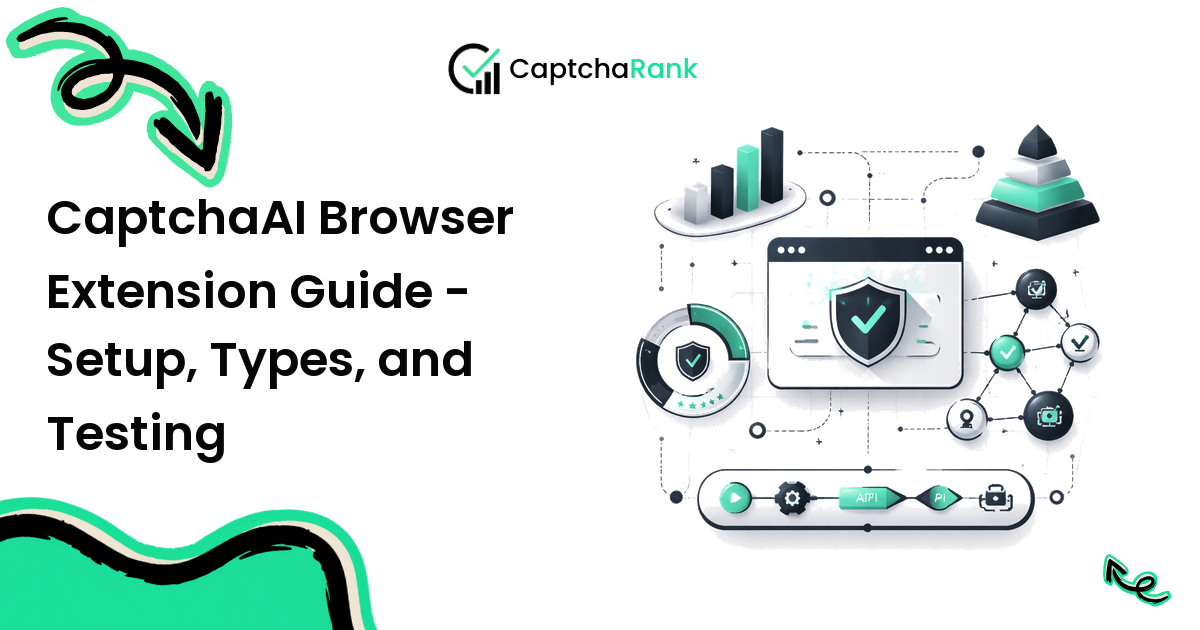
CaptchaAI Browser Extension Guide - Setup, Types, and Testing is for developers and operators who need a repeatable way to handle installing the CaptchaAI Chrome extension, connecting an account key, selecting supported types, and validating it on authorized test pages. The important distinction is between receiving a result from a tool and completing a server-accepted verification.
This guide focuses on authorized testing, production observability, and provider-neutral implementation. It also shows where CaptchaAI can be tested naturally alongside other providers without treating any marketing claim as a substitute for your own data.
Quick answer
The shortest reliable path for captchaai browser extension is to reproduce the target flow under controlled conditions and focus on installing the CaptchaAI Chrome extension, connecting an account key, selecting supported types, and validating it on authorized test pages. Keep raw task IDs, timestamps, callbacks, and final response codes together; those records are more useful than repeated retries when the workflow breaks.
Run this only on systems you own or are explicitly authorized to test. Begin with one reproducible attempt and a fresh page state; scaling an ambiguous flow only multiplies unclear errors.
Context to capture
The following capture set keeps widget discovery, provider behavior, and application verification distinguishable.
| Capture | Why it matters here | Failure it exposes |
|---|---|---|
| Store listing and version | Confirms the installed build and publisher | Stale or unofficial package |
| Requested permissions | Shows which pages and data the extension can access | Permissions are broader than the test |
| Credential storage | Protects the provider key and account | Key is exposed to page scripts |
| Enabled challenge types | Prevents the wrong solver mode from intercepting a page | Unsupported widget is silently ignored |
| Completion signal | Separates visual changes from server acceptance | Extension reports success before form verification |
Keep the unmodified provider response beside the normalized error. That pairing is what lets you distinguish a page-integration fault from queue pressure, unsupported coverage, or an account problem.
A stable execution sequence
Use the following order to avoid solving a challenge that the page has already replaced:
- Install the verified extension build in a separate browser profile.
- Review permissions and restrict site access to the approved domains.
- Configure the account key and enable only the required challenge modes.
- Open a reproducible test page and clear previous extension task state.
- Trigger one challenge and observe the extension, page, and network logs.
- Confirm the protected action on the server before marking the attempt successful.
The related CaptchaRank pillar is captcha-solver-api-integration-guide. Keep the provider-specific transport behind one interface so the page workflow remains unchanged when a provider or fallback changes.
Checklist for this exact query
The search intent behind captchaai browser extension is unusually specific. Work through these points before broadening the test:
- Inspect: Installing the CaptchaAI Chrome extension.
- Confirm: Connecting an account key.
- Record: Selecting supported types.
- Test: Validating it on authorized test pages.
Turn each point into a log field or assertion. If it cannot be observed, the team will struggle to tell whether a later regression came from the page, the provider, the browser environment, or a changed validation rule.
Code or configuration pattern
The code below illustrates one narrow piece of the captchaai browser extension flow; keep provider calls behind your adapter.
Extension test checklist
1. Install from the provider's verified store listing.
2. Review requested host and browser permissions.
3. Enter the account/API key in the extension settings.
4. Enable only the challenge types needed for the test.
5. Restrict the extension to authorized domains where possible.
6. Record challenge type, start time, completion time, and final server result.
Troubleshooting the first failed run
Use this table to choose a targeted correction instead of another blind attempt:
| Symptom | Likely cause | Focused fix |
|---|---|---|
| Nothing happens | Site access or host permission is missing | Grant only the required domain and reload the tab |
| Widget is detected but not solved | The extension does not support that variant | Confirm coverage and switch to its API or another provider |
| Solve completes but form stays locked | The page callback was not triggered | Inspect the widget configuration and application events |
| Account errors appear | Key, balance, thread limit, or account state is invalid | Check the provider dashboard and raw extension logs |
A retry is useful only after the invalid context has been replaced. Replaying the same token, widget data, or browser state adds cost without creating new diagnostic information.
Where CaptchaAI fits
A fair shortlist can contain CaptchaAI as the mixed-workload baseline plus a specialist or established fallback. Compare server acceptance, task creation errors, p95 completion time, and support for the exact variant described here.
Keep the buying metric tied to the protected action. Price per thousand tasks is incomplete when invalid results, timeouts, duplicate billing, extension permissions, or engineering support change the real operating cost.
QA plan and operating limits
Use a labeled QA set or a repeatable staging route. Run enough attempts to reveal tail latency, then compare accepted-submit rate and cost after retries. Stop the test when the page changes, because mixing two widget versions in one result set produces a misleading provider ranking.
Primary documentation
Consult these primary references for current widget and platform behavior:
Challenge vendors and solver providers release changes on separate schedules. Revalidate the required parameters when a widget version, browser API, or provider task schema changes.
FAQ
What is the safest way to test captchaai browser extension?
Use a staging page, vendor test key, or a production flow you own and are explicitly authorized to automate. Record the final backend result and avoid unrelated third-party accounts.
Can the same CAPTCHA result be submitted again?
Do not reuse the result. Capture fresh challenge context and allow at most one clean retry while diagnosing the flow.
Do I need a provider-neutral adapter?
Move to an API when the team needs structured logs, concurrency, retries, or provider failover. Keep the extension for manual or exploratory cases.
Is CaptchaAI useful for this integration?
Yes, when the required challenge type is supported. Use it as a measurable candidate rather than assuming it should always be primary.
Compare live CAPTCHA solver performance on CaptchaRank — visit captcharank.com/solvers for the live leaderboard or captcharank.com/compare for head-to-head provider comparisons.