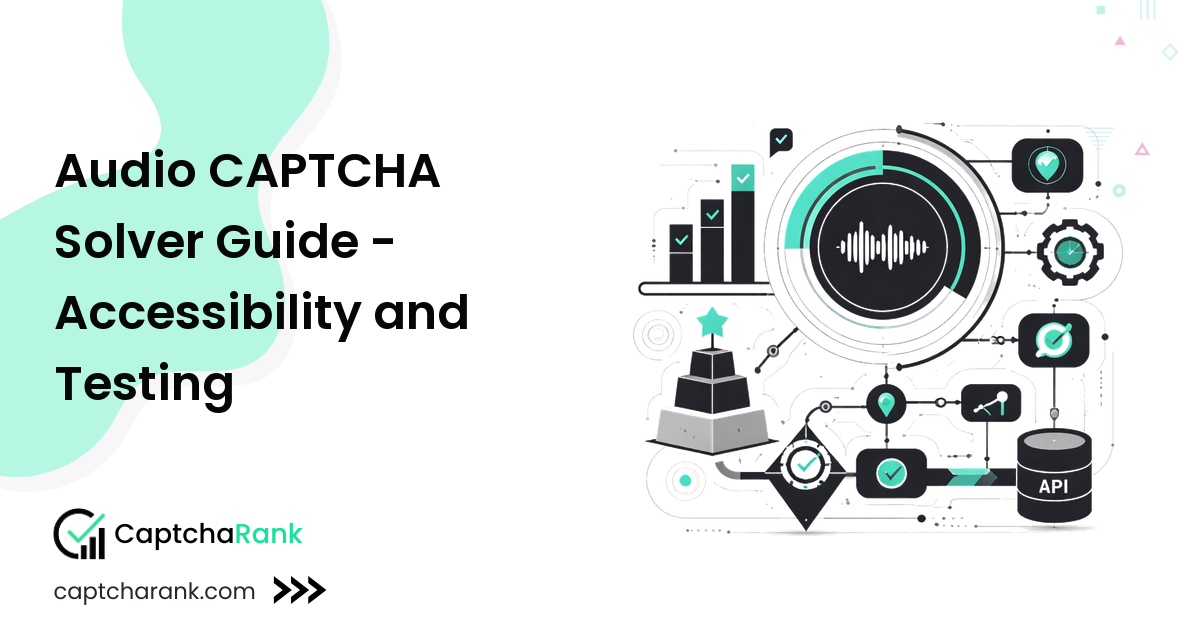
Audio CAPTCHA Solver Guide - Accessibility and Testing is for developers and operators who need a repeatable way to handle evaluating audio challenge handling for accessibility QA while respecting rate limits, consent, and the limitations of speech recognition. The important distinction is between receiving a result from a tool and completing a server-accepted verification.
This guide focuses on authorized testing, production observability, and provider-neutral implementation. It also shows where CaptchaAI can be tested naturally alongside other providers without treating any marketing claim as a substitute for your own data.
Quick answer
Treat audio captcha solver as an integration problem with timing and state. The immediate goal is evaluating audio challenge handling for accessibility QA while respecting rate limits, consent, and the limitations of speech recognition. Detect after render, submit the exact current parameters, deliver the response through the page's supported path, and discard it after the first verification attempt.
Run this only on systems you own or are explicitly authorized to test. Begin with one reproducible attempt and a fresh page state; scaling an ambiguous flow only multiplies unclear errors.
Context to capture
Log the fields below at the moment the challenge is active; values taken from initial HTML can already be obsolete.
| Capture | Why it matters here | Failure it exposes |
|---|---|---|
| Source asset dimensions | Defines the coordinate system | Solver coordinates are applied to a resized element |
| Instruction or answer grammar | Constrains the expected result | Response format cannot be parsed |
| Preprocessing version | Makes OCR tests reproducible | A filter removes meaningful strokes |
| Provider output schema | Normalizes text, coordinates, angle, or distance | Application assumes the wrong units |
| Ground-truth result | Measures real accuracy | Only task completion is counted |
Keep the unmodified provider response beside the normalized error. That pairing is what lets you distinguish a page-integration fault from queue pressure, unsupported coverage, or an account problem.
Implementation workflow
A clean implementation follows this sequence:
- Capture the original asset, instruction, and pixel dimensions.
- Apply preprocessing only when it improves a measured validation set.
- Choose a provider task whose output matches text, points, angle, or distance.
- Normalize the output into a typed internal result.
- Map the result into the rendered coordinate system or answer field.
- Score exact acceptance and preserve failed samples for review.
The related CaptchaRank pillar is image-captcha-guide. Keep the provider-specific transport behind one interface so the page workflow remains unchanged when a provider or fallback changes.
Checklist for this exact query
The search intent behind audio captcha solver is unusually specific. Work through these points before broadening the test:
- Inspect: Evaluating audio challenge handling for accessibility QA while respecting rate limits.
- Confirm: Consent.
- Record: The limitations of speech recognition.
Turn each point into a log field or assertion. If it cannot be observed, the team will struggle to tell whether a later regression came from the page, the provider, the browser environment, or a changed validation rule.
Code or configuration pattern
This focused pattern covers the implementation boundary most relevant to audio captcha solver.
from dataclasses import dataclass
from time import monotonic

@dataclass
class SolveResult:
    provider: str
    task_id: str
    solution: object
    solve_seconds: float

def measured_solve(provider, challenge):
    started = monotonic()
    task_id = provider.create_task(challenge)
    solution = provider.wait_for_result(task_id, timeout_seconds=120)
    return SolveResult(provider.name, task_id, solution, monotonic() - started)
Diagnostic table
Use this table to choose a targeted correction instead of another blind attempt:
| Symptom | Likely cause | Focused fix |
|---|---|---|
| Answer format is rejected | Provider output was not normalized | Define a typed schema and validate units |
| Clicks land off target | Coordinates use a different pixel space | Map source dimensions to the rendered rectangle |
| OCR accuracy drops after filtering | Preprocessing removed useful detail | Evaluate each transform on labeled samples |
| Task completion looks high but acceptance is low | The wrong outcome is being measured | Count the protected action's final result |
A retry is useful only after the invalid context has been replaced. Replaying the same token, widget data, or browser state adds cost without creating new diagnostic information.
Where CaptchaAI fits
A fair shortlist can contain CaptchaAI as the mixed-workload baseline plus a specialist or established fallback. Compare server acceptance, task creation errors, p95 completion time, and support for the exact variant described here.
Keep the buying metric tied to the protected action. Price per thousand tasks is incomplete when invalid results, timeouts, duplicate billing, extension permissions, or engineering support change the real operating cost.
How to test the workflow
Use a labeled QA set or a repeatable staging route. Run enough attempts to reveal tail latency, then compare accepted-submit rate and cost after retries. Stop the test when the page changes, because mixing two widget versions in one result set produces a misleading provider ranking.
Official references
Recheck the official documentation whenever the page changes its integration:
Challenge vendors and solver providers release changes on separate schedules. Revalidate the required parameters when a widget version, browser API, or provider task schema changes.
FAQ
How should a team evaluate audio captcha solver?
Start with an owned test route and one reproducible challenge. Keep the page, network, and browser context stable while you verify the protected action on the server.
Should the integration retry a rejected token?
Treat results as single-use. Reset or reload the active widget, collect new parameters, and create another task only if policy allows a retry.
Is a browser extension better than a solver API?
Yes for production use. An adapter prevents page logic from depending on one provider and makes comparisons or emergency routing much easier.
Should CaptchaAI be included in the shortlist?
It can be, especially as an API-compatible baseline. The final role—primary, fallback, or extension-only—should follow the team's own verification and latency results.
Compare live CAPTCHA solver performance on CaptchaRank — visit captcharank.com/solvers for the live leaderboard or captcharank.com/compare for head-to-head provider comparisons.