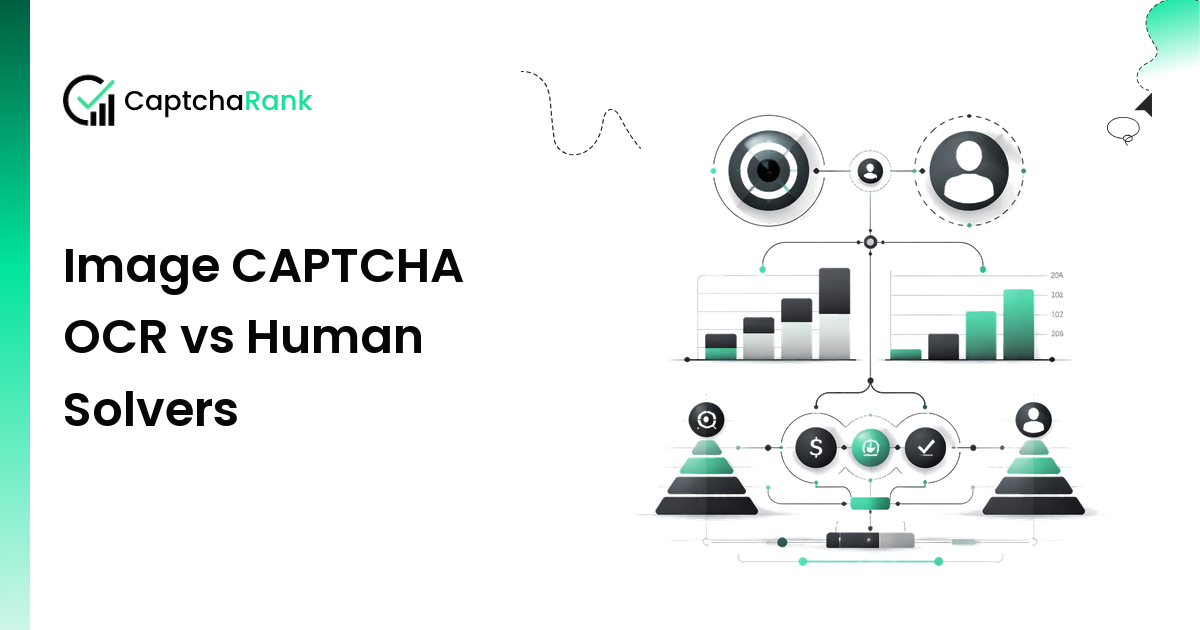
For text and image CAPTCHAs, the solver market splits into two architectures: OCR / ML solvers that classify the image with a vision model in under a second, and human-powered solvers that route the image to a worker pool that returns the answer in 10–20 seconds. Most of the major providers (2Captcha, Anti-Captcha) actually offer both — the CAPTCHA goes to the OCR pipeline first and falls through to a human worker if the model is uncertain.
For an automation engineer the choice (and the price) depends on which type of image CAPTCHA you are solving. This article lays out the trade-offs with current benchmark data.
For background on image CAPTCHAs themselves, see the image CAPTCHA guide. For ranked solver picks see best image CAPTCHA solver.
The two architectures
| Aspect | OCR / ML solver | Human-powered solver |
|---|---|---|
| Avg latency | 0.5–2s | 10–20s |
| Accuracy on simple text | 95–99% | 99% |
| Accuracy on distorted text | 70–90% | 99% |
| Accuracy on novel/custom CAPTCHAs | <50% | 95% |
| Cost / 1k solves | $0.30–0.80 | $1.00–2.00 |
| Throughput cap | Effectively unlimited | Limited by worker pool |
| Time-of-day effect | None | Slower at off-peak |
Where OCR wins
OCR is the right pick when:
- The CAPTCHA is simple text (4–6 alphanumeric chars on a clean background).
- You are solving high volume (>10k/day) and latency matters.
- The CAPTCHA is a known type the provider's model has been trained on.
- You are budget-constrained.
Common OCR-friendly cases: legacy phpBB / vBulletin forum captchas, simple "type the characters" challenges on older login forms, basic anti-spam fields on contact forms.
Where humans win
Human solvers are the right pick when:
- The CAPTCHA uses heavy distortion, overlapping characters, or unusual fonts.
- The CAPTCHA is custom-rendered by the site (not a known third-party widget).
- The CAPTCHA is image-classification (pick the cats) at OCR-resistant difficulty.
- You need >95% accuracy and can absorb 10–20s latency.
Common human-favored cases: math CAPTCHAs ("what is 7 + 4?"), context-dependent image classification, site-specific custom CAPTCHAs the OCR has never seen.
The hybrid model
Most major providers (2Captcha, Anti-Captcha, CapMonster, CaptchaAI) operate a hybrid pipeline:
- CAPTCHA arrives at the API.
- Routed to the OCR / ML model. If confidence > threshold, return.
- If confidence below threshold, route to a human worker.
- Worker's answer is fed back into the training dataset.
The pricing reflects this: text-CAPTCHA endpoints are priced at the OCR cost ($0.50/1k typical). Custom or "unknown type" endpoints are priced at the human-worker cost ($1.50/1k typical).
What you actually pay (current data)
Based on current CaptchaRank benchmark data:
| Provider | Simple text (OCR) | Distorted text (hybrid) | Custom image |
|---|---|---|---|
| CaptchaAI | $0.50 / 1k | $0.99 / 1k | $1.49 / 1k |
| 2Captcha | $0.50 / 1k | $1.00 / 1k | $2.00 / 1k |
| Anti-Captcha | $0.70 / 1k | $1.00 / 1k | $2.00 / 1k |
| CapMonster Cloud | $0.30 / 1k | $0.80 / 1k | n/a |
| DeathByCaptcha | $1.39 / 1k | $1.39 / 1k | $1.39 / 1k |
CapMonster is OCR-only (no human fallback), which explains the lower headline price and the gap on custom challenges. DeathByCaptcha is human-only with a flat per-solve price regardless of difficulty.
For the full pricing matrix see pricing comparison.
Latency in practice
Run a quick test against the same challenge with both endpoints:
import time, requests

def time_solve(api_key, image_b64, method):
    t0 = time.time()
    resp = requests.post("https://2captcha.com/in.php", data={
        "key": api_key, "method": method, "body": image_b64, "json": 1,
    }).json()
    task_id = resp["request"]
    while True:
        time.sleep(1)
        r = requests.get("https://2captcha.com/res.php", params={
            "key": api_key, "action": "get", "id": task_id, "json": 1,
        }).json()
        if r.get("status") == 1:
            return time.time() - t0, r["request"]

# OCR-only endpoint
ocr_time, ocr_answer = time_solve(KEY, image, "base64")
# Human fallback endpoint
human_time, human_answer = time_solve(KEY, image, "post")
Typical results on simple text: OCR ~1s, human ~12s. On distorted text: OCR ~2s with 75% accuracy, human ~15s with 99% accuracy.
Decision framework
Use OCR if your cost_per_solve × volume is dominant in your budget AND the CAPTCHA is in the OCR-friendly bucket. Use the human / hybrid endpoint if accuracy × cost_of_failure is dominant.
Concrete thresholds:
| Volume / day | CAPTCHA difficulty | Pick |
|---|---|---|
| > 100k | Simple text | OCR-only (CapMonster, CaptchaAI OCR) |
| 10k–100k | Mixed | Hybrid (CaptchaAI, 2Captcha) |
| < 10k | Custom / hard | Human (Anti-Captcha, DeathByCaptcha) |
| Spiky | Anything | Hybrid with auto-fallback |
FAQ
Is open-source OCR (Tesseract) good enough? For very simple text CAPTCHAs sometimes yes (~80% accuracy after training), but for anything modern the hosted OCR providers are 10–15% more accurate and significantly faster.
Do human workers see my data? Yes — that is the architecture. Do not send PII or sensitive document content through human-solver endpoints. Most providers anonymize, but the worker sees the image.
Is the OCR endpoint always cheaper? At list price yes, but if your accuracy is below the site's verify threshold, the failed solves cost you more than a slightly more expensive human solve would have.
Which provider has the best image-CAPTCHA accuracy? The current ranking is on captcharank.com/solvers — refreshed continuously.