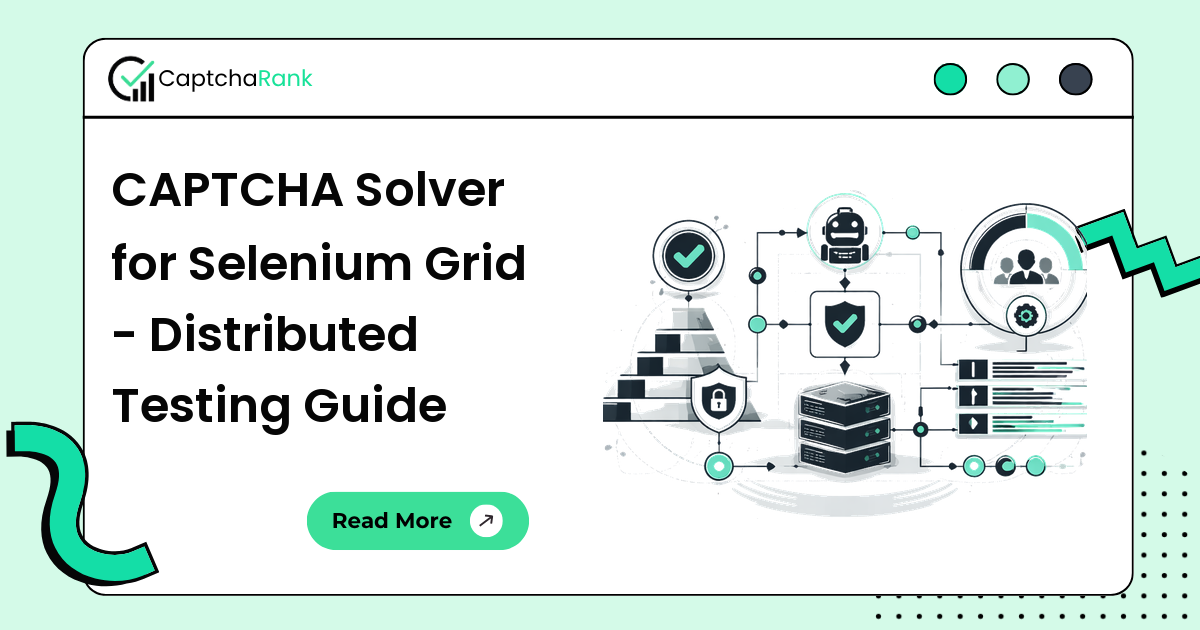
CAPTCHA Solver for Selenium Grid - Distributed Testing Guide covers coordinating solver calls, browser capabilities, proxy identity, and result delivery across distributed Selenium nodes. The useful implementation is not a provider call pasted into Selenium Grid; it is a small, observable boundary that protects credentials, respects task deadlines, and records whether the target application accepted the result.
This guide uses CaptchaAI naturally as one API option and keeps the surrounding design provider-neutral. Apply the workflow only to applications and test environments you own or are explicitly authorized to assess.
Where Selenium Grid fits
Teams searching for captcha solver selenium grid usually have a specific blocked test or automation path. The useful goal is coordinating solver calls, browser capabilities, proxy identity, and result delivery across distributed Selenium nodes. This should be limited to systems, accounts, and test data the team owns or has explicit authorization to exercise.
First ask whether a real solver belongs in the test. Official vendor test keys, a staging bypass, or a mock provider are better for most regression suites. Use live provider tasks when the purpose is to measure the CAPTCHA integration itself, verify fallback behavior, or reproduce a production-only failure.
A stable Selenium Grid design
The browser session and solver task must share a traceable context. In Selenium Grid, capture the session ID, browser capabilities, route, proxy label, challenge instance, provider task ID, and final application result. Keep solving outside the browser driver, then deliver the result through page-owned fields and callbacks.
Link the implementation to CaptchaRank's captcha-solver-api-integration-guide pillar so provider selection and framework mechanics remain separate concerns. The application should own challenge IDs, deadlines, authorization, and final verification; the provider gateway should own field mapping and transport.
Pre-flight checklist
Capture these items for every captcha solver selenium grid attempt:
- Browser and node ID
- Proxy and user-agent label
- Challenge instance
- Provider task ID
- Trace/screenshot/network artifact
Add task creation time, token delivery time, and the final protected action to the same record. That timeline separates provider latency from queue delay, browser delay, framework timeout, and a token that sat too long before verification.
Selenium Grid example
The example below illustrates the boundary most relevant to captcha solver selenium grid. Keep credentials server-side, replace demo values with the current live challenge context, and add application-specific authorization before exposing any endpoint.
from selenium import webdriver

options = webdriver.ChromeOptions()
options.set_capability("se:name", "captcha-authorized-flow")
driver = webdriver.Remote(
    command_executor="http://selenium-grid:4444",
    options=options,
)

# Keep provider, proxy label, browser session ID, and node capability
# together in the same structured test log.
Managing the asynchronous result
In Selenium Grid, create a local job record before the first provider request for captcha solver selenium grid.
Persist browser and node id, proxy and user-agent label, and the absolute application deadline. Move through queued, submitted, pending, delivered, accepted, or failed states; do not infer success from a returned token alone.
Use the final application response to close the job. When node cannot find the response field, apply this fix: Return to the page-owned context before delivery. Never recycle a token after it has been submitted once.
Common Selenium Grid problems
| Symptom | Likely cause | Focused fix |
|---|---|---|
| Node cannot find the response field | Driver switched frames or documents | Return to the page-owned context before delivery |
| Only one Grid node fails | Browser/proxy capabilities differ | Compare node labels and preserve session artifacts |
| Trace shows token but backend rejects | Challenge context aged or mismatched | Create the task later and align browser identity |
Preserve the original provider error, local job state, and final application response. A normalized message is useful for users, but the raw evidence is what lets engineering distinguish unsupported coverage, a framework bug, provider degradation, and stale challenge context.
Primary and fallback evaluation
A good shortlist can use CaptchaAI as the compatibility baseline plus a second provider for fallback testing. Do not start both on every task: use challenge coverage and error-family policy so cost remains tied to actual accepted actions.
Use cost per accepted protected action—not advertised price per task—as the commercial metric. Include timeouts, invalid results, duplicate creation, fallback usage, and engineering effort. A cheaper task can be the expensive route when the framework repeatedly submits unusable results.
How to roll this out safely
Roll out the Selenium Grid path behind a feature flag or a small authorized test cohort. Add a per-run spend limit, a concurrency ceiling, bounded exponential backoff, and an accepted-action metric before increasing traffic. Use trace/screenshot/network artifact as the release gate, because provider-side completion is not proof that the protected operation succeeded.
Create one alert for “Only one Grid node fails” and retain enough redacted evidence to test whether browser/proxy capabilities differ. Keep development, staging, and production credentials separate; rotate them without editing source code. For this Selenium Grid integration, the minimum dashboard should show accepted-submit rate, p95 end-to-end time, pending-task age, retry ratio, fallback share, and cost per accepted action.
Official references
Use these primary sources to confirm current Selenium Grid behavior and CaptchaAI request fields:
Frameworks, browser tools, and CAPTCHA providers evolve independently. Recheck official documentation when a runtime, SDK, widget version, or provider response schema changes.
FAQ
Should captcha solver selenium grid run in every automated test?
Usually not. In Selenium Grid, use vendor test keys, a controlled application bypass, or a mock adapter for ordinary regression coverage. Reserve live solver tasks for the dedicated path that validates coordinating solver calls, browser capabilities, proxy identity, and result delivery across distributed Selenium nodes.
Where should the CaptchaAI key be stored in Selenium Grid?
Use Selenium Grid's server-side or runtime secret mechanism and restrict access to the component that submits tasks. Treat proxy and user-agent label as sensitive configuration; never expose the key in client bundles, source control, build layers, screenshots, or shared reports.
How long should Selenium Grid poll for a result?
Stop at an absolute local deadline that leaves time for trace/screenshot/network artifact. Pending status can use bounded intervals, but a configuration error should fail immediately. If node cannot find the response field, fix driver switched frames or documents before creating another task.
What is the success metric for captcha solver selenium grid?
Count the final server-accepted protected action and link it to browser and node id. Task creation, a ready provider result, or a completed Selenium Grid callback is an intermediate event, not the business outcome.
Does this Selenium Grid integration need a fallback provider?
Add one when the protected workflow justifies the extra complexity, then route only on failure classes a second provider can improve. If trace shows token but backend rejects, investigate challenge context aged or mismatched first; racing two providers for every challenge creates duplicate cost and ambiguous token ownership.
Compare live CAPTCHA solver performance on CaptchaRank — visit captcharank.com/solvers for the live leaderboard or captcharank.com/compare for head-to-head provider comparisons.