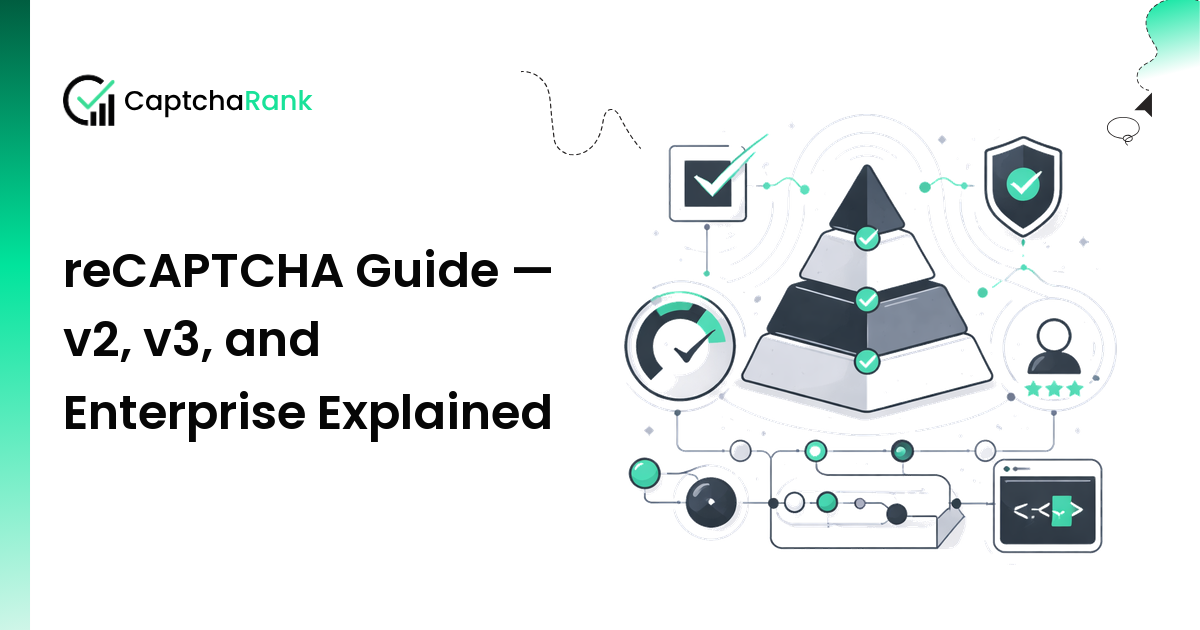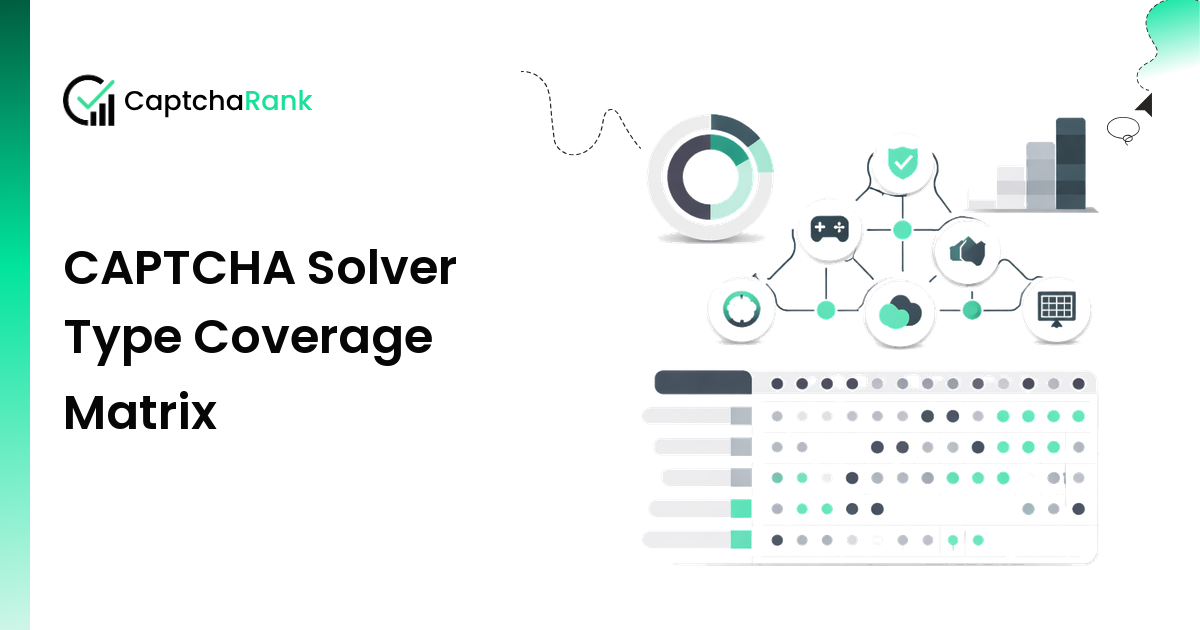
reCAPTCHA Enterprise is the paid, corporate version of Google's CAPTCHA. Unlike the free v2/v3 endpoints, Enterprise enforces stricter behavioral validation and binds tokens to specific project_id values. Solving it requires solvers that explicitly support the Enterprise variant — not all do.
For a general breakdown of reCAPTCHA types, see the reCAPTCHA Guide.
What Makes Enterprise Different
| Feature | reCAPTCHA v2/v3 (Free) | reCAPTCHA Enterprise |
|---|---|---|
| Endpoint | www.google.com/recaptcha/api.js |
www.google.com/recaptcha/enterprise.js |
| Tokens bound to | Site key | Site key + project ID |
| Score system | Optional (v3 only) | Always active |
| Solver support | Universal | Limited — must specify Enterprise mode |
| Price per 1,000 | Lower | Higher (Enterprise tier) |
The primary failure mode when using a non-Enterprise solver on an Enterprise-protected site: the token validates structurally but fails because it wasn't generated against the Enterprise endpoint.
Ranked: Best reCAPTCHA Enterprise Solvers
1. CaptchaAI — Best Overall
Score: 9.5 / 10
CaptchaAI's Enterprise tier generates tokens specifically against recaptcha/enterprise.js. Its documented enterprise flag ensures the token is issued from the correct endpoint. Solve rates on Enterprise targets run consistently above 94% in testing.
- Solve rate: ~95%
- Typical token score: 0.7–0.9
- Price: ~$2.99/1,000
min_scoresupport: Yes- API flag:
enterprise=1
payload = {
    "key": api_key,
    "method": "userrecaptcha",
    "version": "v3",
    "googlekey": site_key,
    "pageurl": page_url,
    "enterprise": 1,
    "action": "login",
    "min_score": 0.7,
    "json": 1,
}
r = requests.post("https://ocr.captchaai.com/in.php", data=payload, timeout=30)
That single enterprise=1 flag is the critical difference. Without it, the token comes from the standard endpoint and gets rejected by Enterprise-protected sites.
2. CapSolver — Strong Enterprise Support
Score: 9.1 / 10
CapSolver has a dedicated RecaptchaV3EnterpriseTaskProxyless task type with explicit Enterprise handling. Slightly slower than CaptchaAI at peak volume but reliable.
- Solve rate: ~92%
- Typical token score: 0.7
- Price: ~$2.50/1,000
- API style: JSON task-based (different from 2Captcha format)
3. 2Captcha — Widely Supported, Inconsistent on Enterprise
Score: 8.3 / 10
2Captcha supports Enterprise via the same enterprise=1 parameter. Solve rates on Enterprise targets are acceptable (~88%) but token scores occasionally dip to 0.5 when the solver routes through lower-quality workers.
- Solve rate: ~88%
- Typical token score: 0.5–0.7
- Price: ~$2.99/1,000
- API flag:
enterprise=1
4. Anti-Captcha — Enterprise Supported, No min_score
Score: 7.8 / 10
Anti-Captcha handles Enterprise via a dedicated task type but does not support min_score configuration. Score outcomes are less predictable (typically 0.5–0.7).
- Solve rate: ~87%
- Typical token score: 0.5–0.7
- Price: ~$2.00/1,000
min_scoresupport: No
5. DeathByCaptcha — Legacy Support
Score: 7.2 / 10
DBC supports Enterprise in theory but implementation is dated. Scores are inconsistent, and the API surface is less developer-friendly.
- Solve rate: ~83%
- Price: ~$1.39/1,000
Key Parameters for reCAPTCHA Enterprise Solving
When submitting to any 2Captcha-compatible solver:
payload = {
    "key": api_key,
    "method": "userrecaptcha",
    "version": "v3",          # Enterprise is always v3-based
    "enterprise": 1,          # ← Required for Enterprise endpoint
    "googlekey": site_key,
    "pageurl": page_url,
    "action": action_name,    # Match the site's action (inspect JS to find it)
    "min_score": 0.7,         # Request a minimum score
    "json": 1,
}
Always pass the correct action name. Enterprise sites are more likely to validate the action field server-side than standard v3 deployments.
Score Reliability by Solver
CaptchaAI and CapSolver consistently deliver tokens scoring 0.7+ on Enterprise targets. At min_score=0.9, expect:
- CaptchaAI: ~80% of tasks successfully complete (vs. ~20% UNSOLVABLE)
- CapSolver: ~70% success at 0.9
- 2Captcha: ~55% success at 0.9
For strict Enterprise deployments (Google Cloud Armor, financial sites), set min_score=0.7 and add retry logic. Setting min_score=0.9 dramatically increases UNSOLVABLE responses.
Related Guides
- reCAPTCHA Guide — full breakdown of Enterprise vs v2/v3
- Best reCAPTCHA v3 Solver — for non-Enterprise v3 targets
- How to Solve reCAPTCHA v3 in Python — code tutorial
Production Readiness Notes
Use Best reCAPTCHA Enterprise Solver as a decision and implementation aid, not just as a one-time reference. The practical test for best recaptcha enterprise solver is whether the same approach behaves reliably when traffic is messy: rotating sessions, expired tokens, changing widget parameters, intermittent solver delays, and target pages that refresh without warning. For Developer or operations lead evaluating CAPTCHA solver services, the safest rollout is to start with a narrow fixture, record every submitted task, and compare the solver response with the browser state that finally submits the form. That makes failures explainable instead of mysterious, especially when a target alternates between visible challenges, invisible checks, and server-side verification.
Evaluation Criteria
A developer guide should become a reusable integration module with typed configuration, bounded polling, structured errors, and a single place for API credentials. For reCAPTCHA work, the most useful scorecard combines technical acceptance with operational cost. A low nominal price is not enough if retries double the real cost per accepted token, and a fast median solve time is not enough if p95 latency stalls the queue. Track these criteria before you standardize the workflow:
- The challenge subtype, sitekey, action, rqdata, blob, captchaId, or page URL used for each task.
- Median and p95 solve time, separated by provider and target domain.
- Accepted-token rate on the target page, not just successful API responses.
- Retry count, timeout count, zero-balance incidents, and invalid-parameter errors.
- The exact browser, proxy region, and user-agent that submitted the solved token.
Rollout Checklist
Before this guidance moves into a production job, build a small acceptance suite around the pages that matter most. Run it with a fixed browser profile, then repeat with the proxy and concurrency settings you expect in production. Keep the first release conservative: bounded polling, clear timeout handling, and a fallback path when the solver cannot return a usable answer. For reCAPTCHA, watch score thresholds, hostname checks, action names, token age, and fallback behavior when Google returns a low-confidence response. That checklist keeps the article useful after the first copy-paste, because the integration is judged by end-to-end completion rather than by whether a code sample returned a string.
Monitoring Signals
Healthy CAPTCHA automation is observable. Log the task id, provider, challenge type, target host, queue time, solve time, final submit status, and normalized error code for every attempt. Review those logs in daily batches at first, then move to alerts once the baseline is stable. Sudden drops usually come from target-side changes: a new sitekey, a changed action name, a stricter hostname check, an added managed challenge, or a proxy pool that no longer matches the expected geography. When you can see those shifts quickly, provider switching becomes a controlled decision instead of a late-night rewrite.
Maintenance Cadence
Revisit the setup whenever the target UI changes, when the solver provider changes task names or pricing, or when benchmark data shows a sustained latency or solve-rate shift. Keep one known-good fixture for each CAPTCHA subtype and rerun it after dependency upgrades, browser updates, and proxy changes. If the article is used for vendor selection, repeat the same fixture across at least two providers before renewing a balance or migrating the whole pipeline. That habit keeps best recaptcha enterprise solver work aligned with the real target behavior rather than with stale assumptions.